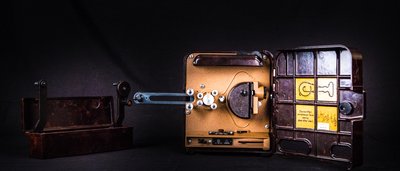
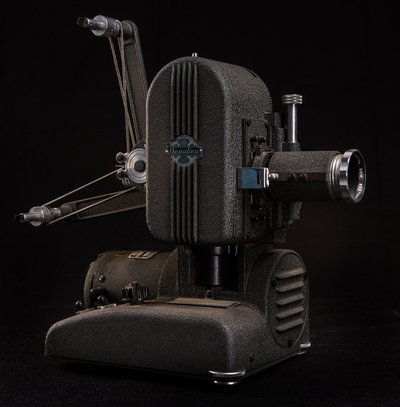
Antoine Heurtier left school at thirteen. Without formal education, the self-taught engineer developed something remarkable in 1937: a prototype projector capable of handling 8mm, 9.5mm, and 16mm film in a single machine. At a time when each film format required its own projector, the 'Supertri' was a revelation. It won a gold medal from the French Ministry of Commerce in 1938.
That same year, Antoine, his brother Jean, and collaborator Montgiraud founded their company in Saint-Étienne — a city known for arms, bicycles, and ribbons, to which they added precision film equipment. The tri-format mechanism, whose drive belt design remained essentially unchanged from 1938 through the 1960s, testified to the soundness of the original engineering.
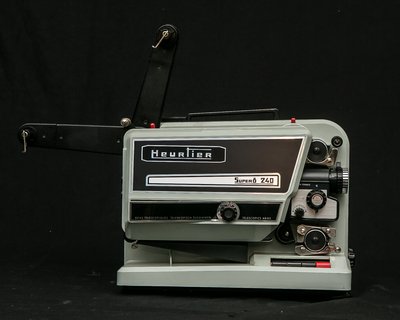
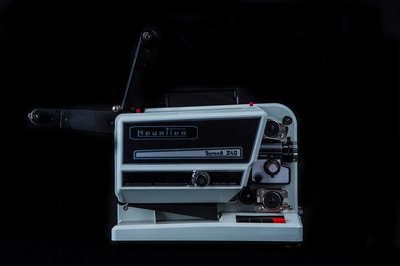
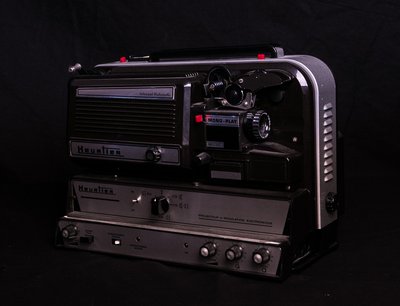
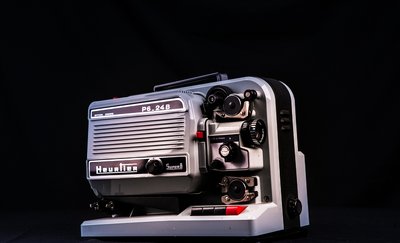
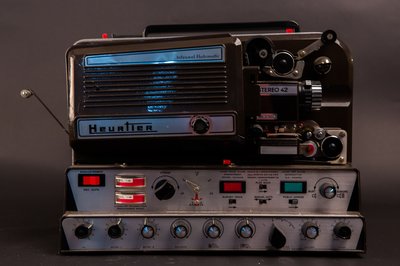
Growth was extraordinary. Annual production went from 300 units in 1959 to 40,000 by 1970 — a 130-fold increase. At peak, 230 employees shipped over 500,000 projectors to 40+ countries. Antoine personally held 65 patents. The Super 8 era brought the P6-24 workhorses, the Stereo 42 (1973) with Schneider-Kreuznach optics, and the 1976 Stereovox — collectors call it 'the steampunk projector' for its imposing industrial design with f/1.1 Schneider lens and 2×15W stereo amplifier.
After 1976 the Heurtier name vanished from catalogs. VHS and Betamax were making film projection obsolete, and a small French specialist couldn't compete on price with Japanese and German giants. The company closed in 1981. But the concept it pioneered — multi-format projection from a single machine — remains unique in projector history.